Sunday, November 10, 2013

X1.1 Solar Flare From Sunspot 1890 - November 10, 2013


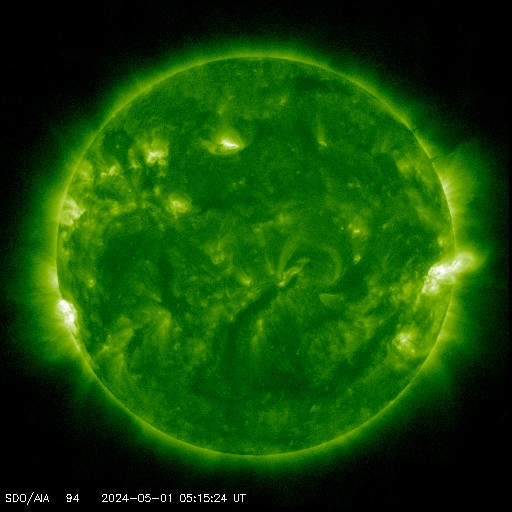
  As seen in the EVE image to the left, sunspot 1890 is directly Earth facing and has just produced a strong X1.1 solar flare at 05:14UTC.

Looking at the latest STEREO images, there is a CME that was produced along with this X flare.
More updated images are needed to tell the direction and speed of this CME. 

Check back often for further updates.


 The Goddard Space Flight Center CME model has been updated. The CME that was produced in association with this X flare is expected to have a direct Earth impact and will arrive late on Nov. 12th through early Nov. 13

November 10 2013 CME

Event Issue Date: 2013-11-10 10:00:59.0 GMT
CME Arrival Time: 2013-11-12 18:39:35.0 GMT
Arival Time Confidence Level: ± 6 hours
Disturbance Duration: 24 hours
Disturbance Duration Confidence Level: ± 8 hours
Magnetopause Standoff Distance: 4.9 Re

Click HERE to view the animated CME model


Friday, November 8, 2013

Sunspot 1890 Is Now Directly Earth Facing


   Monster sunspot 1890 has today rotated into a direct line with Earth, raising the possibility of any geoeffective events over the next 48-72 hours. The size of 1890 has decreased some over the past few days, with a area size of 920 being reported by solen on Nov 8th.


   Even with the decrease in size sunspot 1890 retained a magnetic delta structure in the southeastern section making chances high that we will see more activity from the sunspot over the next few days. NOAA forecasters are estimating a 60% chance of M-class solar flares and a 20% chance of X-flares for Nov 8th.
 
For a complete list of solar flares that we have had during November 2013, please visit our updated Solar Flare List page.


UPDATES:
X1.1 Solar Flare From Sunspot 1890 - November 10, 2013
 
CHANCE OF FLARES: Big sunspot AR1890 has quieted since the X-flare of Nov. 8th, but this could be the calm before the storm. The sprawling Jupiter-sized sunspot has a 'beta-gamma-delta' magnetic field that harbors energy for strong flares. NOAA forecasters estimate a 50% chance of M-class flares and a 20% chance of X-flares on Nov. 10th. credit: Spaceweather.com

Friday, April 12, 2013

M3.3 Solar Flare From Sunspot 1718 - April 12, 2013

   Today we had a M3.3 solar flare from sunspot region 1718 peaking at 20:38 UTC
Today's M3.3 flare comes on the heels of the M6.5 solar flare that occurred yesterday (April 11th) around sunspot region 1719 peaking at 07:16 UTC.


   At this time the M3 flare from today does not appear to have produced a CME. We will however be monitoring the solar images to see if we see any signs of this changing. The M6 flare from yesterday did however produce a Earth directed CME that is due to arrive sometime in the early hours of Saturday April 13, 2013 when a moderate G2 geomagnetic storm is forecasted to occurred.

Event Issue Date: 2013-04-11 11:41:59.0 GMT
CME Arrival Time: 2013-04-13 05:57:21.0 GMT
Arival Time Confidence Level: ± 6 hours
Disturbance Duration: 5 hours
Disturbance Duration Confidence Level: ± 8 hours
Magnetopause Standoff Distance: 4.8 Re


Sunday, March 17, 2013

CME Impact! March 17, 2013


   The full halo CME from Friday March 15th has arrived  at Earth early Sunday morning at around 05:30 UTC . The Solar wind and interplanetary magnetic field show a shock signature from this CME now arriving.
At the time the CME came in contact with Earths magnetosphere a geomagnetic disturbance commenced with the Bz fluctuating between minus 20 and plus 15 nanoTeslas.
The Solar wind speed jumped to around 700 km/s and the interplanetary magnetic field Bz component is turbulent around -15 nT.
This brought on a moderate Geomagnetic storm.


   At this time geomagnetic storm level has reached storm levels of G2 (K=6). These conditions are expected to persist well into the early morning hours of tomorrow, Monday March 18.

Aurora may be seen as low as Montana, Michigan, New York, Wisconsin to Washington state, as well as other high latitude regions. To know where Auroras can be seen, look for the Aurora ovation model located in the left hand column of this site.


Any and All updates will be added to the bottom of this report in the spacial 'UPDATE' section. Be sure to check back often through today to find out about any change in conditions.


Saturday, March 16, 2013

CME Arrival Due Today - Updated Hourly

 
   Today we are awaiting the arrival of a Earth directed CME that was ejected from the solar surface on March 15, 2013. While we wait for this CME to arrive, we thought it would be a good time to update everyone with the info we have on this CME. We have our original report on this CME that you can view HERE.  A geomagnetic storm watch is in effect for the next 24-48 hours when this CME is expected to arrive with G1 (Minor) geomagnetic storm expected for the Saturday March 16th and G2 (Moderate) storming expected for Sunday March 17th. (click HERE to view the Geomagnetic Storm Scales) 
Any and All updates will be added to the bottom of this report in the spacial 'UPDATE' section. Be sure to check back often through today to find out about any change in conditions.

CME arrival is due Today:
March 16th @ 17:00 UTC - March 17th @ 03:00 UTC
March 16th @ 1pm EST - 11pm EST
March 16th @ 10am PST - 8pm PST
(all times are +/- 6hr)
*this CME was traveling away from the solar surface at a speed of  900 km/s (2 million mph) when it left the solar surface.

Event Issue Date: 2013-03-15 09:23:51.0 GMT
CME Arrival Time: 2013-03-16 16:59:03.0 GMT
Arival Time Confidence Level: ± 6 hours
Disturbance Duration: 4 hours

Disturbance Duration Confidence Level: ± 8 hours
Magnetopause Standoff Distance: 4.3 Re
Credit: NASA ISWA

Friday, March 15, 2013

LDE M Flare in Progress - CME Watch In Effect!


   Out of nowhere! At this time there is a LDE (long duration event) M flare in progress . This M class solar flare event began today, March 15th just before 06:00 UTC and is currently at a M1.2 reading. The source of this LDE M flare is sunspot 1692 that is located in the very northern center of the solar disk..  Long duration events such as we are seeing right now are commonly associated with CME's. Because of this, we will be watching close for any signs of a CME that may be ejected toward Earth as well as what sunspot this event took place around. 
New Updates added! Click on the report title to view full report & all new updates.

Today's M flare event started taking place at the same time SWPC issued an alert that there is a Geomagnetic Sudden Impulse. This indicated that the CME we were expecting for March 15th has now arrived


Tuesday, March 12, 2013

Long duration C-Class Flare in progress

   We noticed a filament eruption today near Sunspot 1691 - 1690 located in the northern-center area of the solar disk. 

This filament eruption resulted in a 2 hour long LDE C-Class solar flare that occurred starting at 10:17 UTC and ended at 12:25 UTC 
  
We will update this report if we see a Coronal Mass Ejection (CME) associated with this event. 


   UPDATE: There was a  CME (Coronal Mass Ejection) produced in association with todays event as we can see on STEREO B (here to the left). At this time the CME appears to have a mostly northward trajectory. We are still waiting on STEREO A to update so we can better determine if this CME  will be geoeffective. 
 *Continue to check back often for further updates and alerts as today's solar events unfold.


Monday, March 11, 2013

Another active Region rotating into view

 
The image to the left from NASA SDO shows regions 1692, 1694 and a new region rotating into view.


Sunday, March 10, 2013

Comet PanSTARR Is Showing Up On NASA STEREO Images Today


   Comet Panstarrs reaches perihelion today when it makes its closet approach to the Sun.
We are now seeing this magnificent comet on STEREO B HI1 as we can see in the latest image from STEREO seen here to the left.


   By the evenings of March 12 and 13, comet Panstarrs will be seen in the western skies of the northern hemisphere just after sunset, where we will see this comet close to the crescent Moon.
Image Credit: Skyandtelescope,com


Here we have now an animation of Comet PanSTARRS in highly processed STEREO HI-1B images

 Image Credit: Sungrazing Comets

New large Region gets numbered as 1692

The animated Image from the SDO shows old sunspot region 1678 as it rotates out of view on the 22rd of February and as it reappears as region 1692 on the 10th of March.


Saturday, March 9, 2013

Old Sunspot Region 1678 Returns

   A new active sunspot region is expected to rotate into view during this weekend (March 9-11). This is the well known old sunspot region 1678 making it's return.  In the image to the left we can see also another active region several day's behind it.


   Region 1678 was responsible for the massive CME that occured on the backside of the sun on March 5, 2013 (view that report HERE). Because of the activity sunspot 1678 maintained while on the backside, there has been much anticipation of this sunspot regions return.


Friday, March 8, 2013

Coronal Mass Ejection (CME) Arrives at STEREO

    Maybe you remember the very large solar flare and coronal mass ejection we reported three days ago on March 5. It seems that the Coronal Mass Ejection reached the spacecraft STEREO Behind and the animated image here shows that the Bz component of solar wind remained positive. The time and date can be found in the lower left corner.

That could be one reason why we actually have a time gap on Stereo.

Check Stereo here


Thursday, March 7, 2013

New Sunspot numbered as 1690

  
   We have two sunspot regions which disappeared yesterday while one new region rotated into view over the north-east limb as a single spot HSX Alpha type group at 20 millionths in size and was numbered as region 1690.

 Region 1689 grew from a BXO Beta group at 10 millionths to a DSO Beta type group at 150 millionths in size.


Tuesday, March 5, 2013

Massive solar flare and CME from old Sunspot 1678

   Old region 1678 which is due to return during this coming weekend produced a MASSIVE solar flare and a spectacular full-halo coronal mass ejection.

   Unfortunately, it is not heading our way because this was a farsided event. But its heading for the STEREO Behind spacecraft.


Saturday, March 2, 2013

Increased Solar Activity As We Head Into March


   Today we are seeing an increase in solar activity as a few new sunspots are rotating over the Eastern limb into a more Earth facing position.  This increase gets kicked off with a C1.9 Flare @ 15:11 UTC  and a C1.6 flare @ 18:47 UTC with both C flares coming from the eastern limb located around N08E88. Normally we would not be making much fuss over a couple of C flares, but these two C flare have caught our attention for a few reasons. One, they come after a dry period of no solar flares over the B range for the last week, with last C flare being on Feb 24, 2013 and Two, we have been anticipating the arrival of these new regions as well as the return of old sunspot 1670. All these regions that are about to rotate over the eastern limb have remained active while in the backside of the solar disk and have shown some increase in size. How complex they are or if they remain active while in a direct Earth facing position is yet to be seen in the days ahead. As many have noticed, we are seeing a trend in sunspots becoming non active when they turn into a Earth facing position, only to see them regain their complexity once they near the solar western limb and begin their rotation onto the backside of the solar disk. Image Credit: SDO

Friday, March 1, 2013

Minor Geomagnetic Storm

The solar wind continues to increase this morning and is now over 500 km/s. The Bz component of the Interplanetary Magnetic Field (IMF) was tipped sharply south for several hours and a G1 Geomagnetic Storm is currently underway. We expect aurora at very high latitudes!

 Space Weather Alerts and Warnings Timeline


Thursday, February 28, 2013

New region 1683 numbered

All three sunspot regions remain visible. The largest region 1682 decreased in size during the last 24 hours. It is now a DAI Beta-gamma type group at 110 millionths in size. New sunspot region 1683 was numbered overnight, it is a HSX Alpha type group at 90 millionths in size. There is now more than one spot visible and a bipolar magnetic configuration.
No C class solar flares took place yesterday, the largest solar flare was a B8 from region 1682. Only C class solar flares are expected today.

Wednesday, February 27, 2013

Spectacular Prominence Eruption

Early this morning, a prominence located off the southwest limb erupted.

The Sun spewed out a blob of plasma.


Here you get a close up 


As a result of this we notice a outstanding CME on Soho imagery (Soho Lasco C2 here).

Due to the location of this event (southwest limb),
most of the plasma cloud looks to be heading away from Earth.


Tuesday, February 26, 2013

Full Halo Coronal Mass Ejection (CME)

The STEREO Ahead Spacecraft captured a Full halo Coronal Mass Ejection (CME) this morning. 

The source of this event was a filament eruption inbounded with a solar flare near old region 1678 off the farside of the Sun. 


The Coronal Mass Ejection (CME) will not be geoeffective (farsided event).


Watch the Video down below!


Monday, February 25, 2013

New region rotated into view

Only two small sunspot regions are currently visible. Both are small and quiet so far. However, there is a new region that  rotated into view over the north-east limb. This is a single spot type group and is expected to be quiet. It looks like an 'H' type group with a single (Alpha) magnetic polarity. 'H' type spot groups are usually the last remaining spot of a once multi-spot type group, like the remains of a C or D type group.