Today we had a M3.3 solar flare from sunspot region 1718 peaking at 20:38 UTC
Today's M3.3 flare comes on the heels of the M6.5 solar flare that occurred yesterday (April 11th) around sunspot region 1719 peaking at 07:16 UTC.
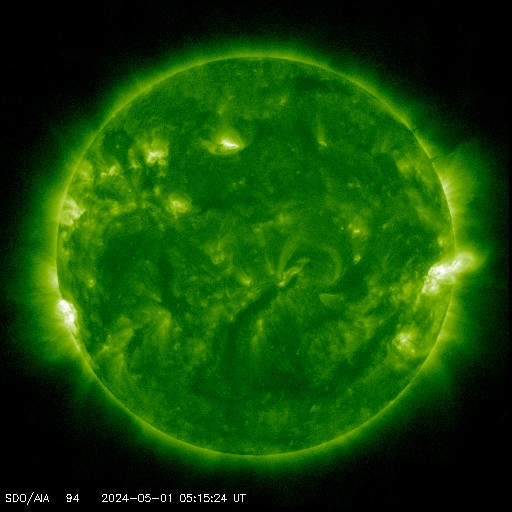
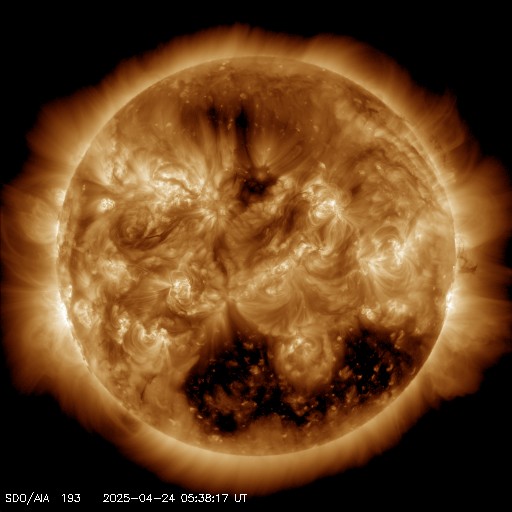
At this time the M3 flare from today does not appear to have produced a CME. We will however be monitoring the solar images to see if we see any signs of this changing. The M6 flare from yesterday did however produce a Earth directed CME that is due to arrive sometime in the early hours of Saturday April 13, 2013 when a moderate G2 geomagnetic storm is forecasted to occurred.
Out of nowhere! At this time there is a LDE (long duration event) M flare in progress . This M class solar flare event began today, March 15th just before 06:00 UTC and is currently at a M1.2 reading. The source of this LDE M flare is sunspot 1692 that is located in the very northern center of the solar disk.. Long duration events such as we are seeing right now are commonly associated with CME's. Because of this, we will be watching close for any signs of a CME that may be ejected toward Earth as well as what sunspot this event took place around. New Updates added! Click on the report title to view full report & all new updates.
Comet Panstarrs reaches perihelion today when it makes its closet approach to the Sun.
We are now seeing this magnificent comet on STEREO B HI1 as we can see in the latest image from STEREO seen here to the left.
By the evenings of March 12 and 13, comet Panstarrs will be seen in the western skies of the northern hemisphere just after sunset, where we will see this comet close to the crescent Moon.
Today we are seeing an increase in solar activity as a few new sunspots are rotating over the Eastern limb into a more Earth facing position. This increase gets kicked off with a C1.9 Flare @ 15:11 UTC and a C1.6 flare @ 18:47 UTC with both C flares coming from the eastern limb located around N08E88. Normally we would not be making much fuss over a couple of C flares, but these two C flare have caught our attention for a few reasons. One, they come after a dry period of no solar flares over the B range for the last week, with last C flare being on Feb 24, 2013 and Two, we have been anticipating the arrival of these new regions as well as the return of old sunspot 1670. All these regions that are about to rotate over the eastern limb have remained active while in the backside of the solar disk and have shown some increase in size. How complex they are or if they remain active while in a direct Earth facing position is yet to be seen in the days ahead. As many have noticed, we are seeing a trend in sunspots becoming non active when they turn into a Earth facing position, only to see them regain their complexity once they near the solar western limb and begin their rotation onto the backside of the solar disk. Image Credit:SDO
You can also find the link to our Forum on the top Tab on any page of My Solar Alerts.
We would like to thank everyone for the continued support as we look forward to another year of shared information :)
Expected CME Update:
this is my unofficial view
this because we have had so much activity with flares and CMEs that we would have to factor in Quantum entanglement.
We have talked about this in extent in the past here.
It is not just about the earth direction and size of a given CME, But there is a LOT of physics that plays into all this as well! Because of this, i do not have enough time to research into all the data and calculations before the arrival of the following CMEs.
So here we go :)
Also lets note that there was a lot of CMEs between July 4th and today, July 7th, that could have been caught up at least partially in a magnetic connection between earth and the sun. thus we could see some mass from these CMEs being caught up with the earth directed CME's and giving a combined hit. i would say we can expect at lease a Kp5 storm starting later tonight, that has the potential of reaching as high as a Kp7 at times, with the geomagnetic conditions being unsettled to Storm conditions over the period of the next 60hrs
With the ionospheric conditions being what they have been from the rash of M flares we have had over a 7 day period (33 M flares and 1 X flare as of the time of this post) combined with the heat wave we have had in North America this past week, i would caution as to the possibility of strong, strange storms for the period that the CMEs are expected to hit/arrive.
Again, this is my unofficial view. I make this blog post only as a informational post of my view with the limited data i have been able to review due to time limitations.
- Ninzrez
We currently have a S1 solar radiation storm in effect that was brought upon by the X1.1 Solar flare and associated CME that occurred earlier today. A greater than 10 MeV Proton event
associated with yesterdays X-class event began at 04:00UTC and peaked at 25 pfu. The proton levels are now subsiding but the S1 storm remains in effect as of 22:19 UTC July 7, 2012.
Global D Region Map as seen on July 8, 2012 @ 04:25
Conditions in the D-Region of the Ionosphere have a dramatic effect on High Frequency (HF) communications and Low Frequency (LF) navigation systems like Loran. The global D-Region Absorption Product depicts the D-region at high latitudes where it is driven by particles as well as low latitudes, where photons cause the prompt changes. This product merges all latitudes using appropriate displays, and is useful to customers such as commercial aviation and maritime users.
SWPC Alert:
Issue Time: 2012 Jul 07 0428 UTC ALERT: Proton Event 10MeV Integral Flux exceeded 10pfu
Begin Time: 2012
Jul 07 0400 UTC
NOAA Scale: S1 - Minor
Potential Impacts: Radio - Minor
impacts on polar HF (high frequency) radio propagation resulting in fades at
lower frequencies.
A X1.1 solar flare has occurred peaking at 23:08 UTC Friday July 6, 2012. Today's X flare comes from large sunspot region 1515.
Continue to check back often for further updates and alerts as todays
solar events unfold. All updates will be added to the
bottom of this report
SUMMARY: X-ray Event exceeded X1
Begin Time: 2012 Jul 06 2301
UTC
Maximum Time: 2012 Jul 06 2308 UTC
End Time: 2012 Jul 06 2314
UTC
X-ray Class: X1.1
Location: S18W50
NOAA Scale: R3 -
Strong
Potential Impacts: Area of impact consists of large portions of the
sunlit side of Earth, strongest at the sub-solar point.
Radio - Wide area
blackout of HF (high frequency) radio communication for about an hour.
---------------------------------------------------------------------- SUMMARY: 10cm Radio Burst
Begin Time: 2012 Jul 06 2304 UTC
Maximum
Time: 2012 Jul 06 2306 UTC
End Time: 2012 Jul 06 2306 UTC
Duration: 2
minutes
Peak Flux: 520 sfu
Latest Penticton Noon Flux: 158
sfu
Description: A 10cm radio burst indicates that the electromagnetic burst
associated with a solar flare at the 10cm wavelength was double or greater than
the initial 10cm radio background. This can be indicative of significant radio
noise in association with a solar flare. This noise is generally short-lived but
can cause interference for sensitive receivers including radar, GPS, and
satellite communications.
UPDATE @ 02:44 UTC July 7, 2012
There has been some question about the discrepancy seen between the GOES 3day Xray flux and the 5min Xray flux. We have noticed that the calibration for the 3 day Xray flux is off by around a 1.0 margin and has been that way for about a week now. Any M flare that we have had this week that was around M1 range has been showing on the 3day GOES Xray flux as a high C flare. Note the M flares on here and count how many M flares you see for July 6th
Any M that registered around a M1 range was shown on the 3 day Xray flux as a high C. Now this X1 occurred and it does the same and shows this X1.1 flare on the 3day as a high M. The 3 day Xray graph is around a 1.0 mark off. We have written to NOAA/SWPC about this issue.
UPDATE @ 01:08 UTC July 7, 2012
ALERT: Type IV Radio Emission
Begin Time: 2012 Jul 06 2322
UTC
Description: Type IV emissions occur in association with major eruptions
on the sun and are typically associated with strong coronal mass ejections and
solar radiation storms.
We now see there IS a CME associated with this X flare event. Earth is well connected with the region of 1515. This CME was not directly Earth directed as it was ejected to the south and west. but a glancing blow to Earth's magnetosphere is likely late on July 9th into the 10th
X-FLARE: Giant sunspot AR1515 unleashed a strong X1.1-class solar flare on July 6th at 2308 UT. Because Earth is well-connected to the blast site by solar magnetic fields, a fusillade of protons accelerated by the explosion might soon reach our planet.
At this time, the geomagnetic conditions are unsettled with a Kp 5
Issue Time: 2012
Jul 06 2246 UTC ALERT: Geomagnetic K-index of 5
Threshold Reached: 2012 Jul 06 2241
UTC
Synoptic Period: 2100-2400 UTC
Active Warning: Yes
NOAA Scale: G1 -
Minor
Potential Impacts: Area of impact primarily poleward of 60 degrees
Geomagnetic Latitude.
Induced Currents - Weak power grid fluctuations can
occur.
Spacecraft - Minor impact on satellite operations possible.
Aurora
- Aurora may be visible at high latitudes, i.e., northern tier of the U.S. such
as northern Michigan and Maine
Thank you for choosing "My Solar Alerts" for your Solar Weather updates
Today at 13:23 UTC a M1.4 solar flare occurred around sunspot region 1476. This new sunspot region is located on the far Northeastern limb of the solar disk and is today rotating into a more Earth directed position. As this region rotates over the Northeast limb, we can see it has a large leading penumbra making more major flares from 1476 possible. This will bring a rise in the quiet solar activity we have seen over the last few months. We will be keeping a close eye on the solar activity and update you all with any changes or events that occur
.
Update: Region 1476 produced 2 more M flares
A M1.3 flare peaking @ 23:02 UTC May 05 and a M1.1 flare peaking at 01:18 UTC May 06
You can view the total M & X flare Count at anytime by viewing our Solar Flare Count page HERE
We also have a very large Coronal Hole that is rotating the Earth facing side of the sun right now. The solar winds from this Coronal Hole are expected to arrive on or around May 9th
Sunspot Region 1429 has produced a M6.3 solar flare at 03:22 UTC March 9, 2012. There was a Earth directed CME produced in association with this flare event. With a estimated ejection speed of 750 km/s the expected arrival time for the CME is on March 11, 2012 around 06:49UTC (+ or - 6hrs.)
We will update the details of this expected CME as more data becomes available.
Today there remains a strong chance for continued major flaring. NOAA has a 40% chance of an X-class solar flare today from sunspot region 1429.
Be sure to check back often for further updates on this event.
All updates will be added to the bottom of this report
Here we can see the Earth directed CME as it appears on STEREO B
Region 11429 [N17E03] lost penumbral area with the main penumbra fragmenting into smaller penumbrae. The region still has several magnetic delta structures and could produce further major flares. The region was the source of a long duration major M6.3 event peaking at 03:53 UTC on March 9. STEREO-B indicates that another full halo CME was produced by this event.
One magnetic delta structure was gone in region 11429 after the LDE and the center of the region is becoming quite open. Several new ARs had spots at 10:00 UTC, see the most recent high resolution CHARMAP. S1517 was located at S23E33, S1518 at S26E23 while S1519 was at N06W25. AR 11431 has developed slowly today, and there is spot development in the southern part of region 1428 as well.
Due to the position of the CME source region close to the solar central meridian, we expect a nearly central encounter of the resulting ICME, which will probably be a magnetic cloud with leading southward field. A strong geomagnetic storm (K = 7 or higher) is probable.
ALERT: Proton Event 10MeV Integral Flux exceeded 1000pfuBegin Time: 2012 Mar 07 1410 UTC
NOAA Scale: S3 - Strong
Potential Impacts: Radiation - Passengers and crew in high latitude, high altitude flights may experience increasing radiation exposures. Astronauts on EVA (extra-vehicular activity) are exposed to elevated radiation levels.
Spacecraft - Single-event upsets to satellite operations, noise in imaging systems, and slight reduction of efficiency in solar panels are likely.
Radio - Degraded or episodically blacked-out polar HF (high frequency) radio propagation.
Update 17:40 UTC March 9, 2012:
This Solar Proton Event continues into today
Issue Time: 2012 Mar 09 1740 UTC
EXTENDED WARNING: Proton 100MeV Integral Flux above 1pfu expected
Extension to Serial Number: 57
Valid From: 2012 Mar 07 0300 UTC
Now Valid Until: 2012 Mar 10 1200 UTC
Warning Condition: Persistence
Starting at around 04:29 UTC today, We had a CME arrival. This CME was caused by a filament that became unstable on March 4th and was ejected from the solar surface.
A Kp6 (moderate G2) geomagnetic storm was reached today around 08:52 UTC. This G3 storm has now subsided to the current conditions of of a G1 storm.
There was also another CME that occurred on March 4th that could have combined with the filament and arrived at the same time. We will monitor solar conditions today and report on any changes that are seen.
Issue Time: 2012 Mar 07 1454 UTC ALERT: Geomagnetic K-index of 6
Threshold Reached: 2012 Mar 07 1448 UTC
Synoptic Period: 1200-1500 UTC
Active Warning: Yes
NOAA Scale: G2 - Moderate Potential Impacts: Area of impact primarily poleward of 55 degrees Geomagnetic Latitude. Induced Currents - Power grid fluctuations can occur. High-latitude power systems may experience voltage alarms. Spacecraft - Satellite orientation irregularities may occur; increased drag on low Earth-orbit satellites is possible. Radio - HF (high frequency) radio propagation can fade at higher latitudes.
Aurora - Aurora may be seen as low as New York to Wisconsin to Washington state
The first signs of the CME from Feb 24th are now being seen.
ACE showed an increase in solar wind and density starting at 20:58 UTC
A G2 Geomagnetic Storm is expected.
Conditions from yesterday's CME impact continue into today, Feb 27, 2012.
Solar wind speed and density are slowly rising, and the Bz has now dipped into the negative.
ACE Data: Solar wind is now at: 488.7 km/sec Density is now at: 7.7 protons/cm Max density reached: 36.3 @ 01:27 UTC Feb 27th
High latitudes be on the watch for auroras :)
We will be updating this report as conditions with this CME arrival change. Be sure to check back often.
Here we have the most recent images of the nict magnetosphere simulation
What we can see now is a new large Coronal Hole that was created by this solar tsunami. This new Coronal Hole was created just to the West of where today's filament ejection/solar tsunami was and to the East of sunspot region 1421. As we can see on the images, this new Coronal Hole is quite large.
Here, we can see what the solar disk looked like before the filament ejection and solar tsunami. Comparing this image to the one above (taken post solar tsunami) we can see where the new large coronal hole was created.
Winds from this new Coronal Hole should reach earth around Feb 26-28
What do we see on the SDO images today? That would be a Lunar eclipse of the SDO (Solar Dynamics Observatory) satellite that was expected to happen today, Feb 21, 2012
Today, a new fast growing Earth directed sunspot emerged in the Northern region of the solar disk . This new sunspot region will put an end to the 6 day streak of no significant solar flares and the flatlined Xray flux. We should see this new region named sometime today. Any events from this region over the next few days will be Earth directed.
Here we can see this sunspot region as it appears in the very early hours of today. When we compare this image to the most recent image, shown above, we can see the extreme fast growth of this new sunspot region
Update 17:45 UTC - Feb 20, 2012 :
This new sunspot region was named region 1422 and now holds a chance for M and X class events
We are keeping a close watch on the solar activity & will report immediately with any significant changes.
Keep checking back :)
Today, we see an increase in solar Xray activity with a a string of C class flares. C1.4, C7.9, C1.5, C2.7, C7.7, C5.3 and a C2.7. This is due to us seeing the return of old sunspot regions 1402 and 1401 as they appear just over the Eastern limb.
Old sunspot region 1402 has remained a strong sunspot region in it's rotation around the backside of the solar disk.
This region will be making it's official return tomorrow sometime, when it will be renamed by NOAA and given a new number.
Expect solar activity to increase as these regions rotate into a more Earth directed position.
Here is a list of M and X flares we seen from old sunspot region 1402 and 1401 on their last rotation in a Earth facing position
X1.7 Flare on 1/27/2012 @ 18:33 UTC - Sunspot 1402
- CME produced ETA: 16:00 UTC Jan 30, 2012
M8.7 Flare on 1/23/2012 @ 03:59 UTC - Sunspot 1402
- LDE lasting 8hrs
- CME produced ETA: 22:00 utc Jan 24, 2012
M1.1 Flare on 1/23/2012 @ 03:04 UTC - Sunspot 1402
- LDE lasting 8hrs
- CME produced ETA: 22:00 utc Jan 24, 2012
M2.6 Flare on 1/19/2012 @ 15:30 UTC - Sunspot 1402
M3.2 Flare on 1/19/2012 @ 16:05 UTC - Sunspot 1402
- This was a double flare event
- LDE lasting 13hrs. starting 13:43 Jan 19 - ending aprox. 03:00 UTC Jan 20th
- CME produced ETA: 22:00 utc Jan 21, 2012
M1.7 Flare on 1/18/2012 @ 19:12 UTC - Sunspot 1401
M1.0 Flare on 1/17/2012 @ 04:53 UTC - Sunspot 1401
C6.5 Flare on 1/16/2012 @ 04:44 UTC - Sunspot 1402
- LDE lasting 4 hrs. starting 02:36 - ending 06:46
- CME Produced ETA Jan 20th 2012
M1.4 Flare on 1/14/2012 @ 13:18 UTC - Sunspot 1401
There has been a slow steady rise in the Xray flux over the last few hours starting around 20:30 UTC. This is due to an ongoing flare around sunspot region 1410 located on the far western limb of the solar disk.
Update 00:09 UTC Feb 8, 2012 :
This LDE peaked at C7.3 and is now on a slow drop, currently at C2.3
We will update on the flare situation as conditions change.
Keep checking back
UhOh! We have some updated news about the ACE satellite that most of you may find interesting. For about the next week, we will not have reliable data fron the ACE satellite. The following news post was made today by NOAA
2012-02-06 19:01 - ACE Tracking Difficulties
SWPC’s partners that track the ACE satellite have begun to see problems with tracking ACE. The orbit of the ACE spacecraft is about to take it directly in line with the Sun, as seen from Earth. This will happen on February 8th, but ACE is already so close to the Sun that ground stations are having trouble. The Sun acts as a radio noise source, making the signal from ACE difficult to discern above the solar noise (also known as solar Radio Frequency Interference). This has resulted in intermittent availability of the ACE solar wind data. This situation will get worse over the next two days and will then improve over the next several days as the ACE spacecraft moves away from the Sun-Earth line. Models that depend on the ACE solar wind data will also be affected (e.g. the Wing Kp Geomagnetic model). These problems are temporary, but are expected to continue for the next 4 or more days. http://www.swpc.noaa.gov/
Sunspot region 1410 has produced a M1.0 solar flare peaking at 20:00 UTC Feb 6, 2012
We will monitor to see if there was a CME produced in association with this M flare.
Looking at the ACE data, we can see that the CME associated with the Jan 27th X1.7 flare has arrived at arround 15:40 UTC. This CME is expected to only give a glancing blow and not create a geomagnetic storm. We will keep an eye on the ACE data and report if conditions increase or change.
NOAA Alert:
Issue Time: 2012 Jan 30 1653 UTC
SUMMARY: Geomagnetic Sudden Impulse
Observed: 2012 Jan 30 1624 UTC
Deviation: 8 nT
Station: Boulder
2012-01-30 17:15 CME Arrival at Earth from the X1-solar flare
A pulse in the solar wind passed the ACE spacecraft around 1540 UTC (10:40 EST) today. This abrupt increase in speed and magnetic field strength is thought to be from a CME on Friday, January 27. No significant geomagnetic storm activity is expected from this. Another effect of Friday's eruption, a Solar Radiation Storm, continues its leisurely decay and is nearing the end of the event (currently at S1 (Minor) levels). http://www.swpc.noaa.gov/
We are currently having a S2 Solar radiation Storm that was brought on by yesterdays X1.7 solar flare that peaked at 18:33 UTC Jan 27, 2012. http://mysolaralerts.blogspot.com/2012/01/x17-flare-january-27-2012.html
Proton event conditions at this time are ongoing with a slight drop in protons now occurring.
NOAA Space Weather Alert:
EXTENDED WARNING:
Proton 10MeV Integral Flux above 10pfu expected
Valid From: 2012 Jan 27 1826 UTC
Now Valid Until: 2012 Jan 29 1800 UTC
Warning Condition: Persistence
Predicted NOAA Scale: S2 - Moderate

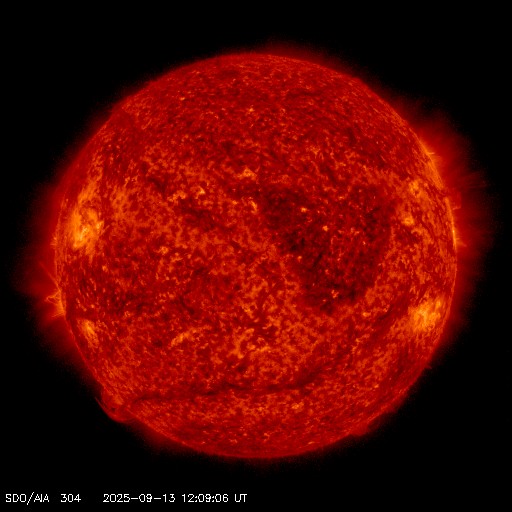
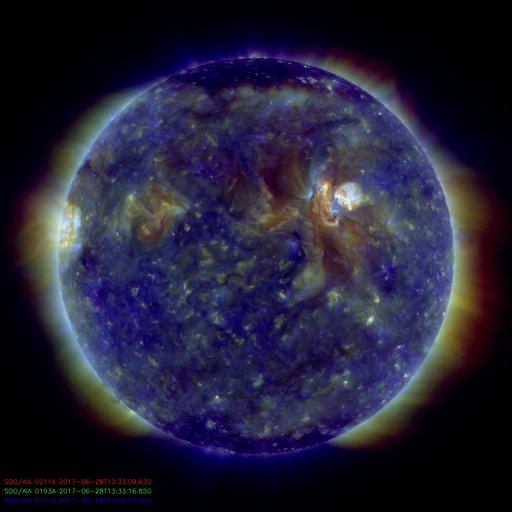
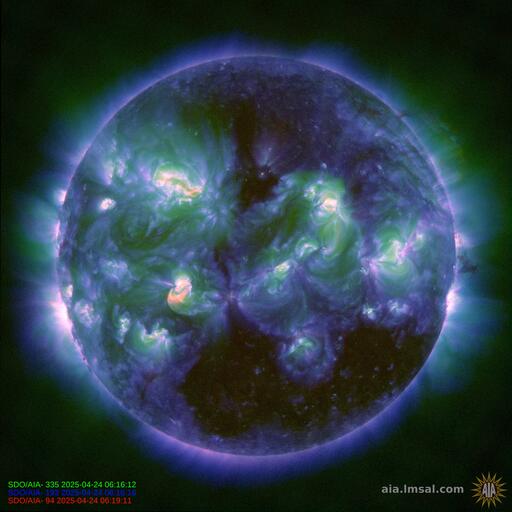
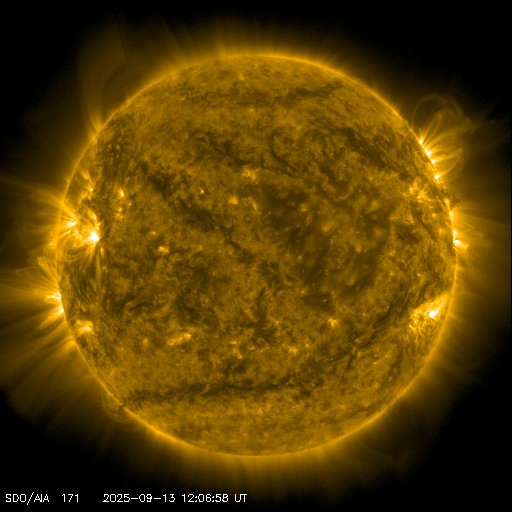

 At this time the M3 flare from today does not appear to have produced a CME. We will however be monitoring the solar images to see if we see any signs of this changing. The M6 flare from yesterday did however produce a Earth directed CME that is due to arrive sometime in the early hours of Saturday April 13, 2013 when a moderate G2 geomagnetic storm is forecasted to occurred.


