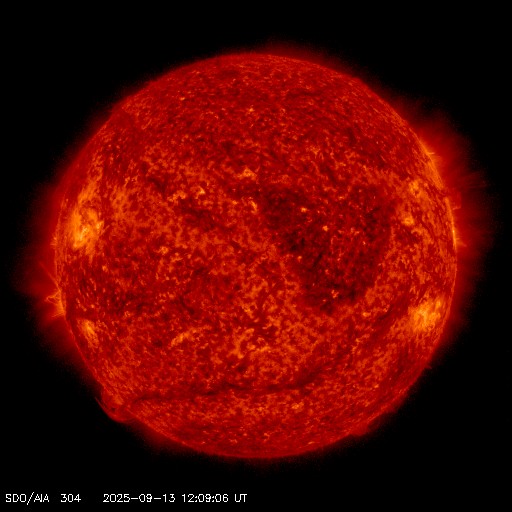
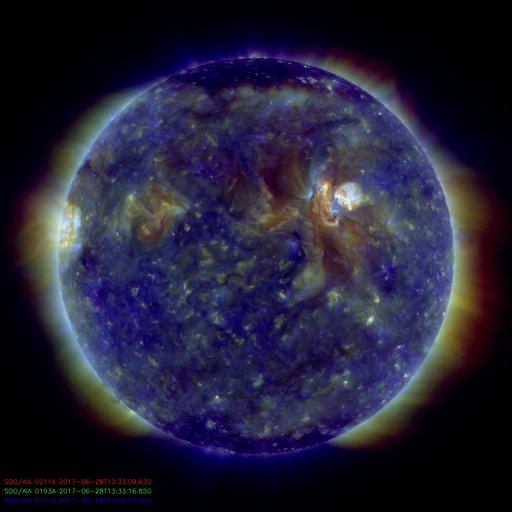
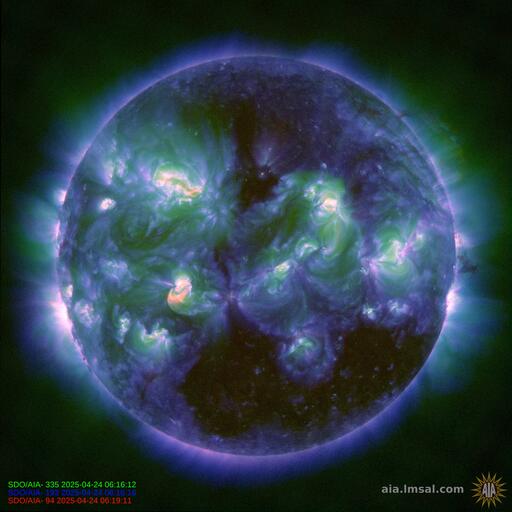
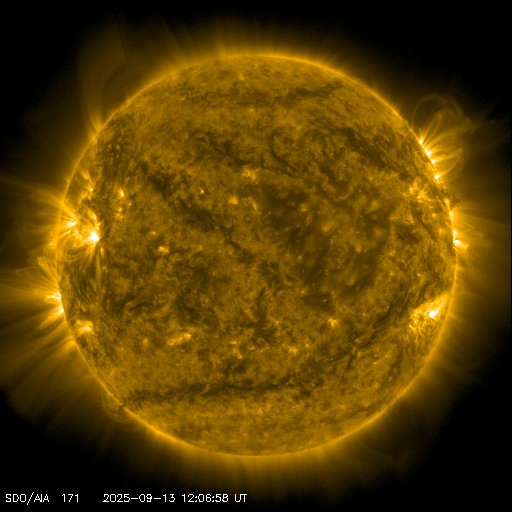
Once again Sunspot Region 1515 has produced a significant event, releasing a M6.1 S/F lasting in duration from 11:39 :00 untill 11:49:00 ,and peaking at 11:44:00 UTC today July 5, 2012. Another M1.2 peaking at 13:17 swiftly followed with a large CME eruption off of the sw limb. Current projections do not see this CME being geoeffective.
Space Weather Message Code: ALTXMF
Serial Number: 174
Issue Time: 2012
Jul 05 1146 UTC
ALERT: X-Ray Flux exceeded M5
Threshold Reached: 2012
Jul 05 1145 UTC
NOAA Scale: R2 - Moderate
Potential Impacts: Area of
impact centered on sub-solar point on the sunlit side of Earth. Extent of
blackout of HF (high frequency) radio communication dependent upon current X-ray
Flux intensity. For real-time information on affected area and expected duration
please see http://www.swpc.noaa.gov/drap/index.html.
Space Weather Message Code: SUMXM5
Serial Number: 93
Issue Time: 2012
Jul 05 1224 UTC
SUMMARY: X-ray Event exceeded M5
Begin Time: 2012 Jul
05 1139 UTC
Maximum Time: 2012 Jul 05 1144 UTC
End Time: 2012 Jul 05 1149
UTC
X-ray Class: M6.1
Optical Class: 1b
Location: S20W32
NOAA Scale:
R2 - Moderate
Potential Impacts: Area of impact centered primarily on
sub-solar point on the sunlit side of Earth.
Radio - Limited blackout of HF
(high frequency) radio communication for tens of minutes.
Space Weather Message Code: SUM10R
Serial Number: 552
Issue Time: 2012
Jul 05 1230 UTC
SUMMARY: 10cm Radio Burst
Begin Time: 2012 Jul 05 1142
UTC
Maximum Time: 2012 Jul 05 1144 UTC
End Time: 2012 Jul 05 1145
UTC
Duration: 3 minutes
Peak Flux: 290 sfu
Latest Penticton Noon Flux:
163 sfu
Description: A 10cm radio burst indicates that the electromagnetic
burst associated with a solar flare at the 10cm wavelength was double or greater
than the initial 10cm radio background. This can be indicative of significant
radio noise in association with a solar flare. This noise is generally
short-lived but can cause interference for sensitive receivers including radar,
GPS, and satellite communications.
These events continue unfoldindg and we will be updating this post with new information and images as the day progresses; so continue to check back here for your latest updates.
Thank you for choosing "My Solar Alerts" for your
Solar Weather updates.
Update @ 14:00:00 UTC
Space Weather Message Code: WARK04
Serial Number: 1958
Issue Time: 2012
Jul 05 1303 UTC
WARNING: Geomagnetic K-index of 4 expected
Valid From:
2012 Jul 05 1302 UTC
Valid To: 2012 Jul 05 1900 UTC
Warning Condition:
Onset
Potential Impacts: Area of impact primarily poleward of 65 degrees
Geomagnetic Latitude.
Induced Currents - Weak power grid fluctuations can
occur.
Aurora - Aurora may be visible at high latitudes such as Canada and
Alaska.
Sunspot Region 1494 produced an M2.1 s/f peaking at 20:06 UTC on June 6, 2012. The SDO, Stereo, and SOHO spacecraft confirm a CME associated with this flare. Although a large portion of the ejecta from this CME was propelled south of the ecliptic, at this time it appears this CME will have a geomagnetic effect on Earth as it passes in 2-3 days.
Type II (est. speed 1148 km/s) and Type IV radio sweeps were also emitted with this flare.
In this image of the X-Flux we can see the M2.1 flare as it was recorded by the GOES Satellites.
In this STEREO Ahead C 2 image we clearly see the CME as it is ejected away from the solar disk. Notice that a large portion of the material is ejected south of the ecliptic away from Earth, but a clearly defined amount of material is also ejected in a full sweep.
In the video below created from SDO Composits of AIA 131, 211, and 335, you can watch this spectacular event unfold as Region 1494 (located south of the ecliptic just right to the center of the disk), unleashes this flare and CME in an Earthward direction.
On May 26, 2012 at approximately 20:47 UTC, a large backside solar eruption occured off of the far west limb of the solar disk producing a backside asymetrical halo CME observed by SOHO LASCO C/2 and C/3.This CME is not expected to be geoeffective. Along with this eruption, Type II, and Type IV radio emmissions were observed. This event began a 10 MeV proton event (NOAA Scale S1), Solar Radiation Storm, that onset May 27 05:05 UTC, with potential impacts being "Minor impacts on polar HF (high frequency) radio propagation resulting in fades at lower frequencies".
This Event was followed by a LDE (Long Duration Event), C 3.1 flare from Region 1492, lasting from 04:35 untill 07:00 UTC May 27, 2012. This LDE further elevated the proton count ending with a 10 MeV proton event that peaked at 2012 May 27 10:45 UTC, End Time: 2012 May 27 1235 UTC, Maximum 10MeV Flux: 14 pfu. Along with this LDE C class flare there was a CME eruption observed from SOHO Lasco C/2 and C/3. Although not highly Earth directed, CMEs produced from this region of the solar surface generally provide Earth with a "glancing blow", so we expect to see an uptic in geomanetic activity with its arrival May 29th - 30th.
A major X5.4 solar flare has just occured at 00:24 UTC March 7, 2012 followed by a X1.3 solar flare occurring at 01:14 UTC.
The X5.4 & X1.3 flares came from sunspot region 1429. This event produced a R3 radio blackout.
Sunspot region 1429 is Earth directed and here was a large dence CME produced with this X class event.
The estimated arrival time of this CME is at between 05:00 and 11:00 UTC March 8th
2012-03-07 01:03 Strong Solar Eruption; Earth-Directed CME Likely
An R3 (Strong) Radio Blackout is now in progress, beginning about 7:00 p.m. EST today. The site of the eruption, previously active Region 1429, is now near center disk, so there's high-potential of an earth-directed CME. In addition, expect the imminent beginning of a Solar Radiation Storm. Analysis now occurring on both fronts http://www.swpc.noaa.gov/
the Xray flux was slowly dropping after the X5.4 solar flare, it dropped to around the X1.0 level, and is right now on a slow rise back up http://www.swpc.noaa.gov/rt_plots/xray_1m.html
currently at a X1.3
this is seen happening a lot of the time when there is a CME produced with the associated solar flare
Here we see this X flare on sdo EVE
NOAA Alerts:
SUMMARY: X-ray Event exceeded X1
Begin Time: 2012 Mar 07 0002 UTC
Maximum Time: 2012 Mar 07 0024 UTC
End Time: 2012 Mar 07 0040 UTC
X-ray Class: X5.4
Location: N17E29
NOAA Scale: R3 - Strong
Potential Impacts: Area of impact consists of large portions of the sunlit side of Earth, strongest at the sub-solar point.
Radio - Wide area blackout of HF (high frequency) radio communication for about an hour.
WARNING: Proton 10MeV Integral Flux above 10pfu expected
Valid From: 2012 Mar 07 0030 UTC
Valid To: 2012 Mar 08 0000 UTC
Warning Condition: Onset
Predicted NOAA Scale: S1 - Minor
Potential Impacts: Radio - Minor impacts on polar HF (high frequency) radio propagation resulting in fades at lower frequencies.
ALERT: X-Ray Flux exceeded M5
Threshold Reached: 2012 Mar 07 0008 UTC
NOAA Scale: R2 - Moderate
Potential Impacts: Area of impact centered on sub-solar point on the sunlit side of Earth. Extent of blackout of HF (high frequency) radio communication dependent upon current X-ray Flux intensity. For real-time information on affected area and expected duration please see http://www.swpc.noaa.gov/drap/index.html.
We have yet another LDE (long duration event) Flare in progress. This flare began around 04:09 UTC and reached a max of C6.4 at 05:49 UTC. This is the third LDE of 2012.
Keep checking back for current updates!
There was a CME associated with
this LDE flare. Due to the location of 1402 on the far Northwest area of the solar disk, this CME is most likley not Earth directed
Images show the sunspot region of the latest C 2.4 peaking at 13:42 UTC. Seems its the old region 1396 which rotates off the west limb . After and before this flare peaks, we noticed ejections on SDO.
Around 10:00 UTC we can see a CME on STEREO A images that match's with the channel eruption on the west limb.
At approximately 04:01 UTC the CME that accompanied the January 16th LDE C 6.5 flare from Sunspot Region 1402 arrived. At 04:01 ACE data showed an increase in proton density from 1.6 P/cc to 8.3P/cc and an uptick in the solar wind from 301.1 K/ps to 343.5 K/ps. This is just the first in a wave of CMEs expected over the next couple of days. This CME is only expected to give a glancing blow, as the majority of it will sweep past Earth in a northward direction. We will be anxiously awaiting the arrival of a larger double CME wave that was associated with the M3.2 LDE on thursday the 19th. The Next CME is expected to arrive Sunday into Monday UTC. Be sure to check back for updates on these developing events.
The original post on this LDE flare and CME can be seen here.
This is a solar activity update to the LED (long duration event) flare that took place around sunspot region 1402 in the early hours of Jan 16th 2012. This LDE flare lasted about 4 hours, starting at 02:36:00 and ended at 06:46:00 with a peak at around 04:44:00. there was a CME that was produced with this LDE flare as we can see here on STEREO B.
View original report here: http://mysolaralerts.blogspot.com/2012/01/long-duration-flare-and-cme.html
Solar flaring activity is expected to reach the M-level due to NOAA ARs 1401 and 1402 (no Catania numbers yet) near the north-east limb. However, an Earth-directed CME associated with flares in these active regions is unlikely.
We had another rise in X-ray Flux. Couple hours aso a C3.9 peaks a 08:12 and now a C5.5 10:38 UTC.
Both flares located this time at Region 1401. We added a new Vid, including the LDE and the latest Flares, we noticed also another small CME.
At the time of this post we are currently seeing a LDE (long duration event) flare from a new sunspot region located off of the NE limb. New Region 1402 is a large DHO class Sunspot Region with a spot count of 7. This ongoing flare is currently at C 6.4, and the latest Stereo images are showing that a CME is accompanying this event. Pictured below are images from SDO EVE, SOHO, SDO AIA 171 telescope, and Stereo Behind, of this ongoing flare and CME. Images Courtesy of NASA SDO, Stereo, SOHO, and GOES.
We have another long duration event. The flare from the active incoming Region on the east limb is still in pogress as you can see and reached now a M flare!
We have a M 1.4 today peaking at 13:18 UT from the actice incoming Region on the east limb
The new Sunspot to the east (close to 1395) gets numbered over night as Sunspot Region 1396.
We noticed some changes at Region 1391. There was a quick development in the southern part of the leading spot section. We can also see that the magnetic structure formed as well. Reporting Soleninfo a chance of M flare is given from this region.
Region 1395 decayed a bit and produced a C 1.5 at 00:58 UT. Another flare comes from that incoming region which produced the long duration flare yesterday. A new Region emerged to the southeast.
Sunspot Regions 1392 and 1394 decayed and disappeared yesterday. Region 1393 is now on the north-west limb and retained its Beta-Gamma magnetic configuration.Region 1391 lost it and returned to a Beta magnetic configuration.
We notived only 3 solar flares yesterday however this morning we had 3. Two of them took place at Region 1393 and one (we can see that in the image) at Region 1395
Weak effects from CH492 could cause a few unsettled intervals on January 12-13.