
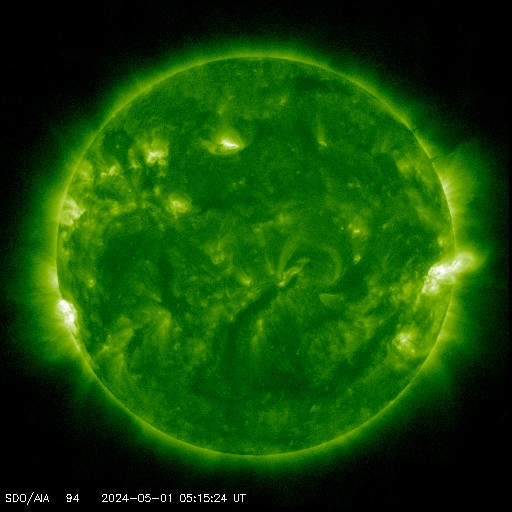
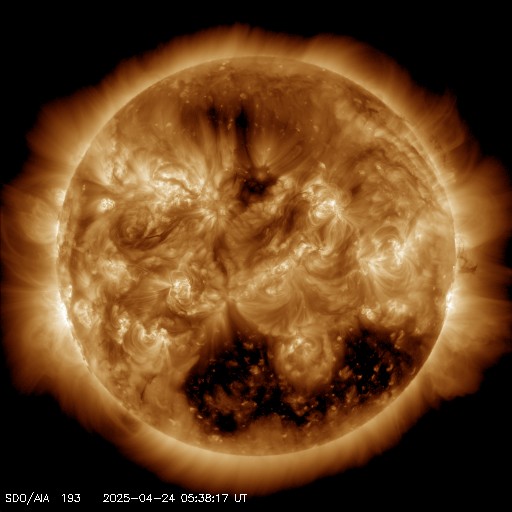

Region 11401 [N17W13] lost penumbral area and gained spots in the trailing spot section while the leading penumbra split into two. If the current separation between the leading and trailing spot section increases the region could be split. M class flares are possible.
Region 11402 [N30W08] remains capable of producing further M class flares. The large penumbra has taken on a symmetrical shape
We had a C7 solar flare peaking at 02:57 UTC and right after that followed by a C3 flare at 04:00 UTC, both from region 1401. We have to remember during the declining phase of large sunspot groups, solar flares can take place as spots disappear and opposing magnetic fields collapse on to each other. A large recurrent coronal hole (CH496) in the southern hemisphere could rotate into an Earth facing position on January 24-26. (CH497) is now in a Earth facing position.


